
Menu
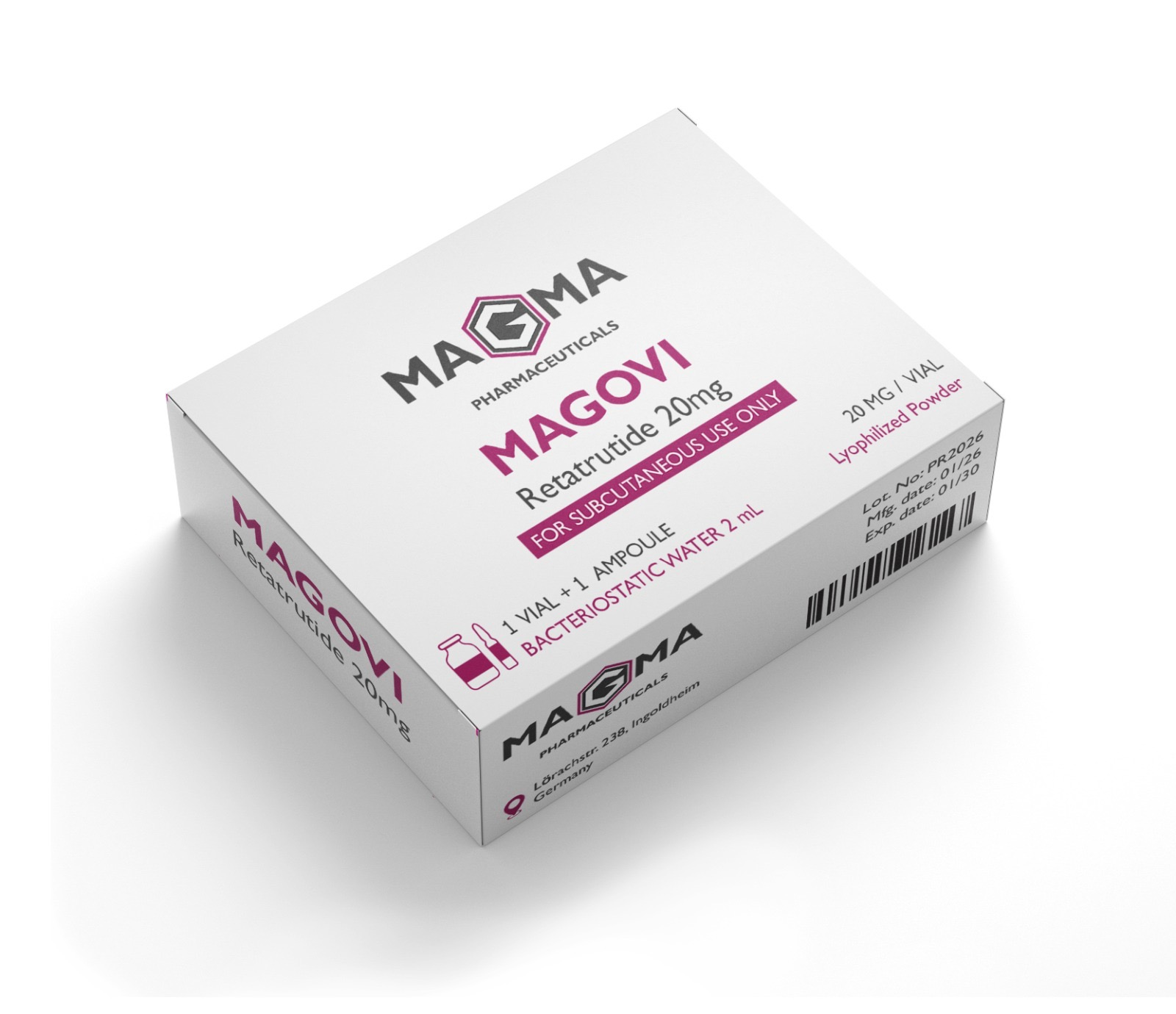
Verify if your MAGOVI is genuine.
WHAT IS RETATRUTIDE?
Retatrutide (also known as LY-3437943) is an experimental medication developed by Eli Lilly that is being studied as a next-generation treatment for obesity, overweight, and related metabolic conditions such as type 2 diabetes. It represents a new class of therapies called “triple agonists,” meaning it simultaneously activates three key hormone receptors: GLP-1 (glucagon-like peptide-1), GIP (glucose-dependent insulinotropic polypeptide), and glucagon. This combined activity helps regulate appetite, improve insulin sensitivity, slow gastric emptying to promote fullness, and enhance fat burning.
Clinical trials have produced striking results. In Phase 2 studies, participants taking higher doses of retatrutide lost an average of up to 24% of their body weight over 48 weeks. Alongside weight reduction, the drug has been shown to improve metabolic health markers, including blood sugar control, hemoglobin A1c, blood pressure, and insulin sensitivity.
Retatrutide is administered as a once-weekly subcutaneous injection. It is not yet approved for general medical use and remains in Phase 3 clinical trials, where researchers are assessing long-term safety, durability of weight loss, and broader metabolic benefits. If these trials prove successful, analysts expect regulatory submission around 2026, with potential market availability in late 2026 or 2027.
HOW RETATRUTIDE DOSING WORKS
Like other incretin-based therapies, Retatrutide follows a titration model, meaning the dose is gradually increased over time to improve tolerability and minimize gastrointestinal side effects. This approach has become the standard with GLP-1 and GIP receptor agonists because rapid introduction at high doses often leads to nausea, vomiting, or diarrhea severe enough for patients to discontinue treatment.
DOSES STUDIED IN CLINICAL TRIALS
Phase 2 trials have explored a wide range of weekly subcutaneous injections, with the following protocols tested:
→ 1 mg per week – Lowest dose, primarily studied for tolerability. Showed modest effects on weight reduction.
→ 4 mg per week – Intermediate dose, with improved weight loss but still below the top-tier results.
→ 8 mg per week – Produced significant reductions in body weight, making it a potential therapeutic sweet spot.
→ 12 mg per week – Highest studied dose; associated with the largest weight loss outcomes, with some participants losing over 24% of their body weight across 48 weeks
STEPWISE ESCALATION
To reach these target doses, participants typically began at lower levels before progressing upward in a stepwise escalation protocol. This gradual titration:
→ Helps the body adapt to incretin stimulation
→ Minimizes dropout rates due to gastrointestinal side effects
→ Allows researchers to monitor biomarkers (blood glucose, cardiovascular markers, liver enzymes) at each stage before moving to the next dose
This careful dosing strategy is what makes Retatrutide not only effective but also tolerable for long-term use.
WHAT IS HALF-LIFE IN PHARMACOLOGY?
In pharmacology, the half-life of a drug refers to the amount of time it takes for the concentration of that substance in the bloodstream to decrease by 50%. This concept is central to understanding how long a drug remains active in the body and how frequently it needs to be administered.
For peptide-based drugs like GLP-1, GIP, and glucagon receptor agonists, half-life is especially important because these compounds are broken down by enzymes relatively quickly unless they are chemically modified to extend their duration of action. Modern incretin-based drugs are engineered to have long half-lives, which allows for weekly injection protocols rather than multiple daily doses.
In the case of Retatrutide, its half-life is what makes weekly dosing both effective and convenient, ensuring continuous metabolic effects without daily injections.
RETATRUTIDE HALF-LIFE: WHAT CLINICAL DATA SHOWS
Early pharmacokinetic studies suggest that Retatrutide has a half-life of approximately 6–8 days, placing it in the same range as other long-acting incretin-based therapies. This extended half-life supports its use as a once-weekly subcutaneous injection, a key feature for patient adherence and convenience.
COMPARISON TO OTHER GLP-1/GIP THERAPIES
→ Semaglutide: Half-life ~7 days, allowing weekly dosing.
→ Tirzepatide: Half-life ~5 days, also suitable for weekly dosing.
→ Retatrutide: Half-life ~6–8 days, providing consistent coverage with potential for slightly longer activity between doses.
This long half-life is one of the main reasons Retatrutide has been able to produce such sustained weight loss and glycemic control in trials, as drug levels remain stable enough to continuously engage all three receptor pathways.
Pasqualotto, Eric, et al. “Effects of once-weekly subcutaneous retatrutide on weight and metabolic markers: A systematic review and meta-analysis of randomized controlled trials.” Metabolism open 24 (2024): 100321.
WHY HALF-LIFE MATTERS FOR DOSING
The half-life of Retatrutide is central to how it is administered and tolerated. With a duration of 6–8 days, the drug maintains therapeutic levels between weekly injections, making treatment simpler and more sustainable for patients.
BENEFITS OF A LONG HALF-LIFE
→ Steady therapeutic levels – reduces peaks and troughs that can cause inconsistent appetite suppression or blood sugar fluctuations.
→ Once-weekly dosing – improves convenience and adherence compared to shorter-acting peptides that require daily or twice-daily administration.
→ Grace period for missed doses – because Retatrutide remains active for several days beyond the 7-day window, patients who miss an injection may still maintain partial therapeutic coverage.
→ Lower side effect risk from fluctuations – gradual clearance reduces the likelihood of sudden withdrawal effects.
This pharmacokinetic advantage places Retatrutide in the same class of convenient, long-acting incretin therapies as semaglutide and tirzepatide, but with the added potency of triple receptor activation.
HALF-LIFE AND WEIGHT LOSS OUTCOMES
The extended half-life of Retatrutide doesn’t just make dosing more convenient — it also plays a major role in how effectively the drug drives weight loss and metabolic improvements.
CONTINUOUS RECEPTOR ENGAGEMENT
Because Retatrutide remains active for 6–8 days, its triple agonist activity is sustained between injections. This means:
→ Appetite suppression persists throughout the week, reducing calorie intake consistently.
→ Slowed gastric emptying continues without major fluctuations, helping with satiety and portion control.
→ Energy expenditure remains elevated due to glucagon receptor activation.
IMPACT ON WEIGHT LOSS TRIALS
In Phase 2 studies, participants maintained steady weight reduction trajectories across the dosing period, with no signs of efficacy “wearing off” between weekly injections. This consistency suggests that the half-life provides continuous pharmacologic coverage, preventing the rebound hunger or cravings that can occur with shorter-acting agents.
IMPLICATIONS FOR REAL-WORLD USE
→ Patients are less likely to experience yo-yo effects between doses.
→ Long half-life supports adherence and lifestyle integration, since forgetting a single day doesn’t immediately disrupt treatment.
→ Consistency may contribute to Retatrutide’s record-setting 24% body weight reduction at 48 weeks in clinical trials.
Li, Wenzhuo, et al. “Structural insights into the triple agonism at GLP-1R, GIPR and GCGR manifested by retatrutide.” Cell Discovery 10.1 (2024): 77.
RETRATRUTIDE VS OTHER GLP-1/GIP DRUGS
Retatrutide’s half-life places it in the same pharmacokinetic class as other long-acting incretin drugs, but its triple agonist mechanism sets it apart in terms of outcomes.
SEMAGLUTIDE (WEGOVY, OZEMPIC)
→ Half-life: ~7 days
→ Dosing: Once weekly subcutaneous injection
→ Profile: Provides steady appetite suppression and glycemic control; proven cardiovascular benefits
TIRZEPATIDE (MOUNJARO, ZEPBOUND)
→ Half-life: ~5 days
→ Dosing: Once weekly subcutaneous injection
→ Profile: Dual GLP-1/GIP agonism improves weight loss and insulin sensitivity; slightly shorter half-life than semaglutide, but still suitable for weekly dosing.
RETATRUTIDE
→ Half-life: ~6–8 days
→ Dosing: Once weekly subcutaneous injection
→ Profile: Triple receptor activity supports more dramatic weight loss outcomes, with sustained pharmacologic coverage across the dosing interval
WHY THE COMPARISON MATTERS
While Retatrutide’s half-life is similar to semaglutide and tirzepatide, its efficacy appears greater because of its triple agonism. The pharmacokinetic profile ensures that this added potency is delivered steadily, without requiring more frequent dosing.
KEEP OUT OF REACH OF CHILDREN
Should BE STORED AT COLD TEMPERATURE 2-8•c (35-46•F)
PROTECT FROM SUNLIGHT
MANUFACTURED AND DISTRIBUTED BY:
MAGMA pharmaceuticals.Ltd
MAGMA Pharmaceuticas®️ adheres to strict international safety and legal guidelines.